

What is a Fibrocartilaginous Embolism
As a stabiliser and supporter of the spine, intervertebral discs allow movement and load distribution between the bones of the spine (vertebrae). Two components of the IVD perform this function: an inner jelly cushion, the nucleus pulposus, and an outer multi-layered ligament, the annulus fibrosus, which contains the nucleus.
There are several causes of spinal problems in dogs, including slipped discs, fractured spines, and fibrocartilaginous embolic myelopathy (FCEM). FCEM is a disease that strikes very suddenly without warning and can be very frightening – however, most affected dogs do recover. Ischemic myelopathy refers to a disease of the spinal cord (myelopathy) that results from a poor blood supply (ischaemia). The spinal cord relies on a continuous blood supply to bring nutrients and remove waste. The spinal cord is supplied with blood by arteries on both sides. When one of these arteries becomes blocked, blood supply to a specific area of the spinal cord is cut off; this damages the nerves.
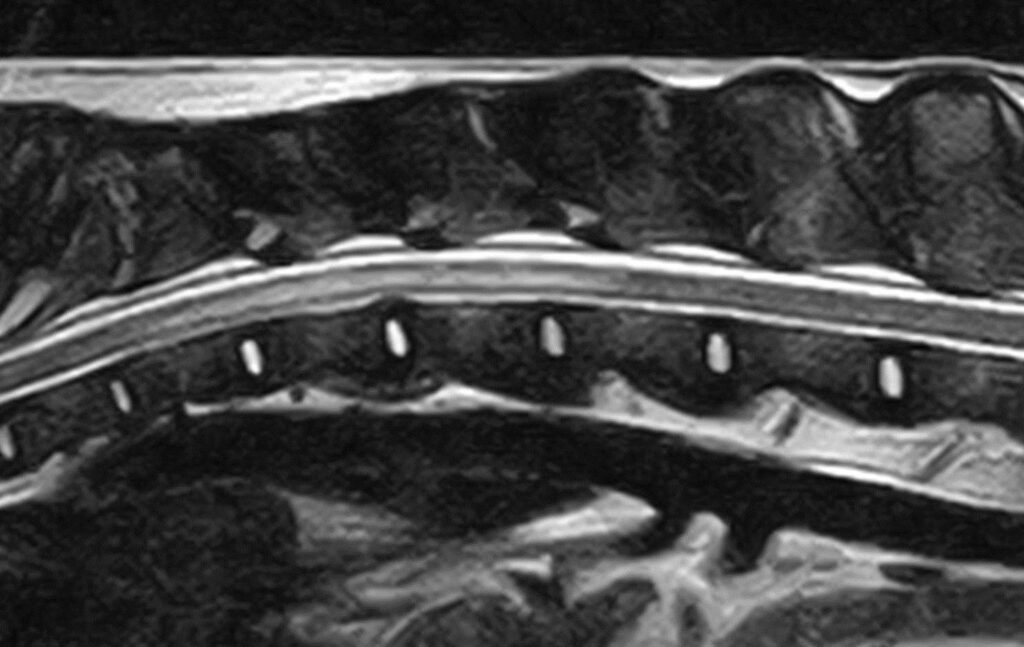
What causes a Fibrocartilaginous Embolism?
The cause of FCEM is not fully understood. Spinal cord injuries occur when a fragment of a disc blocks the blood supply to the spinal cord. Although there are many theories, no one really knows how or why this fragment of intervertebral disc enters the spinal cord artery. A blockage may also be caused by a fragment of a tumour or fat, but this is much less common.
Most commonly, FCEM occurs in mid- to large-breed dogs while exercising (jumping for a frisbee, heavy exercise, etc.), but any breed or age of dog can be affected, as well as cats, horses, pigs, and people.
Dogs can recover from this condition by new blood vessels forming to the affected spinal cord, although this can take some time.
What are the signs of Fibrocartilaginous Embolism?
In dogs (especially giant and large breeds), ischemic myelopathy is a common cause of sudden paralysis, but in cats it is uncommon. It can affect one back leg, both back legs, all four legs or only one side of the body (depending on which part of the spinal cord is affected). This paralysis usually occurs suddenly and does not worsen over time (at least not after the first 24 hours). The symptoms of FCEM are not associated with pain, although some dogs may vocalise when the problem first arises.
There are different ‘grades’ of spinal cord injury according to the severity of the injury:
| Grade | Clinical Signs |
| 1 | Pain only |
| 2 | Walking with weakness and drunkenness in the back legs |
| 3 | Loss of ability to walk with some movements still in the legs |
| 4 | Paralysis with no movement in the legs |
| 5 | Paralysis with loss of feeling when a painful stimulus is applied to the toes |
Other diseases that cause sudden paralysis and may be mistaken for FCEM include a slipped disc (intervertebral disc herniation – see specific fact sheet), spinal fractures and dislocations (broken neck/back), and spinal cord bruising caused by a road traffic accident or a bad fall.
How will I know if a pet has Fibrocartilaginous Embolism?
The diagnosis of ischaemic myelopathy is often made by ruling out other causes of acute paralysis.
In the event that compatible signs suddenly appear, FCEM can be diagnosed in two ways:
- It is important to rule out spinal cord compression resulting from a slipped disc, using an X-ray or CT scan with contrast (myelogram)
- An MRI scan
The results of these tests are usually normal in animals with ischaemic myelopathy although MRI can often show some compatible changes. Since you are relying on an absence of findings on imaging to make a diagnosis it is essential that the correct portion of the spinal cord is checked. Imaging studies may occasionally detect swelling of the spinal cord.
Can Fibrocartilaginous Embolism be treated?
Ischaemic myelopathy has no specific treatment, but most dogs recover within a few weeks if they are still able to feel pain in their feet. It is not necessary to undergo surgery. For the animal to recover, good nursing care is essential (physiotherapy, assisted walking, hydrotherapy, adequate bedding to prevent bed sores). It may take a long time to recover and may require intensive nursing, which can be quite expensive.
Will the dog get better?
The prognosis for recovering from FCEM is determined by the severity of the spinal cord injury. Specifically, the ability of the pet to feel its toes (known as ‘deep-pain’ or nociception) suggests that some nerve fibres still transmit information, and the spinal cord is capable of recovering. Dogs with FCEM who lose this feeling are at a very high risk of developing serious health problems and have a very poor prognosis.
The rate and extent of recovery are variable and difficult to predict. A dog with a mild spinal cord injury can recover quickly and fully. A dog with severe injuries may also recover, but it can take much longer. There may be a negative effect on the outcome if incontinence is present. Following FCEM, animals are usually hospitalised until they are able to urinate on their own.
This problem is very unlikely to recur in an animal’s lifetime.