
Most commonly, cervical spondylomyelopathy (CSM) affects large and giant breeds of dogs, especially Dobermans. Among the many names for the disease, Wobbler syndrome is one of the most well-known. Movement becomes more difficult and the gait becomes abnormal. A veterinary orthopaedic or neurology surgeon usually conducts the investigation and surgical treatment.
What is Cervical spondylomyelopathy?
Wobbler Syndrome is a descriptive name given to a number of conditions affecting the spine of large and giant breeds of dog. Despite being called CSM, the term wobbler describes some of the characteristic signs that are shown by affected dogs, e.g. they appear unsteady or drunk when they walk.
Is a dog likely to develop Cervical spondylomyelopathy?
There are certain breeds of dogs that are particularly prone to developing this condition. Doberman Pinschers, Rottweilers, Bassett Hounds, Irish Wolfhounds and Great Danes are all commonly affected. Young dogs are also susceptible to CSM, but middle-aged animals are most likely to be affected. Genetic predisposition and nutritional problems are believed to interact to cause CSM. It has been suggested that overfeeding or giving nutritional supplements to large breed dogs during their growth could be a contributing factor.
What causes Cervical spondylomyelopathy?
The spinal cord in the neck of dogs with this condition is compressed by abnormalities in the backbone and associated tissues. It can be caused by abnormalities in the shape of the individual neck bones (vertebrae), problems with the way they articulate with each other (joints), problems in the ligaments connecting the vertebrae, or problems with the discs between the vertebrae. This results in some degree of compression of the sensitive spinal cord. A compressed spinal cord results in nerve damage and pain.
How would I know if a dog has Cervical spondylomyelopathy?
Disease symptoms include:
- Incoordination and weakness of the hindlimbs (known as ataxia).
- Lameness in the front legs.
- Pain or stiffness in the neck.
- Complete or partial paralysis.
It usually starts with mild symptoms, such as occasional weakness in the hindlimbs, difficulty getting up from a lying position, and scuffed toe nails. As symptoms progress, affected animals take short abrupt steps with their front limbs. A severely compressed nerve supply to a front limbs can cause lameness.
The signs may appear suddenly (although the disease may have progressed for some time), causing confusion with other causes of severe locomotion problems, e.g. an injury sustained in an accident.
How do I diagnose cervical spondylomyelopathy?
You will probably need to take some X-rays to see what’s going on in the dog’s neck, for which a full general anaesthetic will be required. The use of newer techniques, such as MRI, provides even better views of the problem, but they are also more expensive. The procedure may require a referral to a specialist.
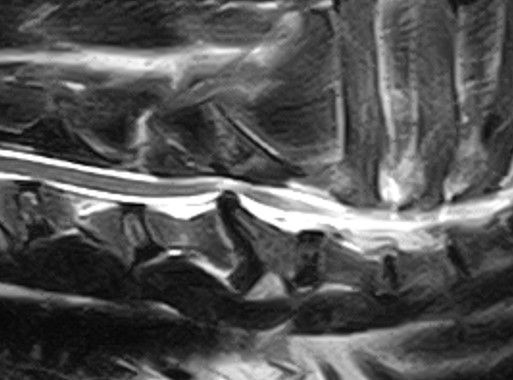
It is possible to determine the nature of the problem in each individual case based on the images obtained. It is important for you to determine exactly where spinal cord compression is occurring so that appropriate treatment can be initiated.
Can cervical spondylomyelopathy be treated?
It is common for dogs with CSM to get worse if they are not treated. In order to improve the quality of life for dogs and prevent further deterioration, surgery is often recommended. A non-surgical approach may be the most appropriate for old dogs or those who are considered a poor surgical risk. Anaesthesia or surgery can be hazardous to Dobermans because of other diseases such as von Willebrand’s disease, which causes poor blood clotting, or hormonal problems such as hypothyroidism or cardiomyopathy. Prior to surgery, it may be recommended that a dog be tested for these conditions.
Surgical procedures are time-consuming, difficult and require specialised knowledge. As well as describing the procedure and outlining the likely prognosis, the surgeon should warn of potential complications.
Will my dog recover from CSM?
A successful surgery can result in a positive outcome for dogs, though it depends on a number of factors. There are several factors that can influence the outcome of spinal cord compression, including the type, the duration, and the dog’s weight and age.